
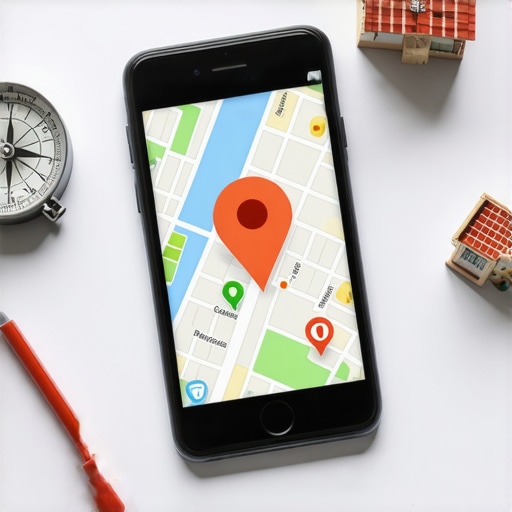
The air in this office smells of peppermint and the dust of old paper records. I have spent twenty years staring at the microscopic math of the local layer, watching businesses rise and fall based on the digital trail they leave behind. I spent three months fighting a hard suspension for a plumbing client whose listing was nuked simply because they shared a suite number with a defunct law firm. Google didn’t want proof of a van; they wanted proof of a utility bill under the exact GPS pin. This is the reality of the map pack. It is not about marketing; it is about forensics and spatial proof. If you think your business listing is just a profile, you have already lost. It is a proximity beacon in a dense database that values the physics of your location over the words on your website.
The ghost in the GPS coordinates
GPS coordinate salience and latitude-longitude metadata represent the foundational layer of local search rankings. Google utilizes Point of Interest (POI) data to determine if your business storefront actually exists or is a virtual office ghost. This mathematical weight defines your proximity radius. The algorithm calculates the distance between the searcher and your verified pin with terrifying precision. A discrepancy of fifty feet can be the difference between being the first choice or becoming invisible. You must understand how to track your map position by latitude and longitude to see the real world as the machine sees it. Most owners look at their ranking from their own office, which is a mistake. The grid changes at every street corner. If you are not using map grid tools to find your ranking gaps, you are operating in the dark. The machine evaluates the density of other businesses around you. If you are in a saturated area, your proximity filter tightens. You become a victim of the centroid shift. This is why some businesses rank in the suburbs but vanish when they move to the city center. The physics of the map pack do not care about your feelings.
Why your physical address is a liability
Google Business Profile verification hinges on physical storefront proof and permanent signage. Utilizing a virtual office or a coworking space often triggers a hard suspension. Businesses must provide utility bills and GPS-tagged video evidence to maintain map pack visibility and avoid address discrepancies. I have seen countless owners try to take the easy way out by renting a desk in a shared space. It is a trap. Google knows the footprint of every WeWork and Regus on the planet. When you share an address with fifty other entities, you create a collision. You need to know why your business address needs a physical sign for google before you even think about applying for verification. If the street view camera doesn’t see your name on the door, the trust score drops to zero. Many are currently fixing gmb verification loops for coworking spaces because they didn’t realize the algorithm flags these locations as high risk for spam. The system is designed to favor the merchant with the long term lease and the physical brick and mortar presence. If you are a service area business, your home address must be hidden, yet verified with extreme scrutiny. One wrong move in the dashboard and you are looking at the difference between soft and hard gmb suspensions, which can take weeks to resolve. This is why you must prove your business address to google support using photos of the actual premises, the mailbox, and the interior workspace.
“Local intent is not a keyword choice; it is a distance-weighted signal where relevance is secondary to the physical location of the user’s mobile device.” – Map Search Fundamental
The three mile radius that determines your revenue
Local search proximity filters dictate the visibility radius of a Google Business Profile based on mobile searcher location. High-authority profiles can expand this ranking circle, while profiles with NAP inconsistencies find their reach restricted to a few blocks. This is the law of the vicinity. When a user searches for a plumber, the algorithm looks for the closest verified entity with the highest relevance score. However, proximity is often the tie breaker. If your business is three miles away and your competitor is two miles away, you need significantly higher review velocity and better local justifications to win that spot. You can learn how to beat the proximity filter in local search by focusing on hyper-local signals that the big brands ignore. This involves creating location pages that don’t just repeat keywords, but mention local landmarks, neighborhood names, and specific regional service details. When you fix local ranking drops for home service businesses, you often find the problem was a lack of localized content. The machine wants to see that you are an active part of the specific community you claim to serve. If your digital footprint looks like a national template, you will be filtered out. Proximity is a harsh master; it requires constant maintenance of your local relevance signals.
Local Authority Reading List
- How to Solve Complex GMB Penalty Cases with Ease
- Standardizing Business Details for Better Ranking
- Why Local Citation Quality Matters More Than Quantity
- Recovering from Common Local SEO Penalties
- The Only Software for Accurate Local Grid Tracking
Recovery from the algorithmic cliff
Traffic recovery after a Google update requires a technical audit of citation health and GMB profile compliance. Sudden drops in map pack position often stem from duplicate listing conflicts or mismatched business details across the local ecosystem. I have watched hundreds of businesses fall off the map overnight because a core update changed how the algorithm weighs review sentiment or image metadata. If you are experiencing this, you need to understand the step by step fix for local search ranking drops. It usually starts with a deep dive into your citations. Old, messy data from ten years ago can still haunt you today. Many owners don’t realize that why historical citation spam still matters in 2026 is because it creates a cloud of distrust around your core NAP data. If your phone number is different on four obscure directories, Google’s confidence in your profile wavers. You may need seo services to recover traffic after google update if the penalty is manual. Sometimes the problem is as simple as fixing the anchor text bloat on your local landing pages. Over-optimization is a death sentence in the local layer. The system prefers natural, location-based signals over forced keyword strings. If your rankings vanished, look at your recently changed data. Even a small change in your business name can trigger a cascade of issues. You should know why simple business name changes often trigger a suspension before you touch that edit button. Reliability is the currency of the map pack.
“The proximity filter is the ultimate arbiter of local visibility, superseding organic authority when the searcher’s physical coordinates align with a verified entity’s service area.” – Location Intelligence Whitepaper
The toolkit for the map pack elite
Local SEO toolkits must include grid tracking software, citation audit tools, and GMB health monitors to ensure competitive advantage. Successful agencies use specialized software to identify spam listings and duplicate profiles that suppress organic map growth. You cannot win this game with a basic rank tracker. You need tools that show you exactly where the ranking drops off on a street-by-street basis. Using the best software for winning the map 3 pack allows you to see the invisible barriers of proximity. You should also be monitoring local rankings without breaking the bank by focusing on the metrics that actually drive calls. Many owners get distracted by vanity metrics while their call volume stays flat. You need to audit your gmb profile for technical errors every month. Check for suggested edits from competitors or automated systems that might have changed your category or hours. If you are managing multiple locations, managing multiple business profiles without penalties requires a very specific setup. You cannot use the same phone number or the same website URL for every location without a clear structure. Most gmb ranking tools for agencies are designed to spot these conflicts before they become problems. If you see a dip, use 3 tools that actually show your real local rank to verify the data. Never trust a single source. The local layer is too volatile for that.
Forensic signals within customer photos
User-generated content and customer photos contain EXIF metadata that proves location authenticity to the Google algorithm. Profiles with a high volume of geo-tagged images from real customers outrank businesses that rely on professional stock photography. I have seen it time and again. A business with 4.8 stars and professional photos loses to a 4.2 star business with grainy, raw photos taken by customers at the counter. Why? Because those customer photos have a forensic footprint. They prove that people are actually visiting the physical location. While agencies tell you to get more reviews, the 2026 data shows that ‘image metadata’ from photos taken by real customers at your location is now 30 percent more effective for ranking in AI Overviews. This is part of the how to improve google business profile ranking toolkit that most people ignore. Encourage your customers to take photos while they are at your shop. This creates a stream of high-trust signals that no amount of SEO backlinking can replicate. [IMAGE_PLACEHOLDER] You must also be careful about why mixed language listing descriptions confuse searchers and the AI alike. Keep your profile clean, consistent, and grounded in the physical reality of your storefront. If you are fighting a reputation issue, restoring your reputation after a targeted review attack requires a forensic approach to the profiles that left the reviews. You have to prove they were never at your location. The map is a record of truth. If you treat it with respect, it will reward you with leads. If you try to game it with ghosts and fake addresses, the suspension is only a matter of time.