
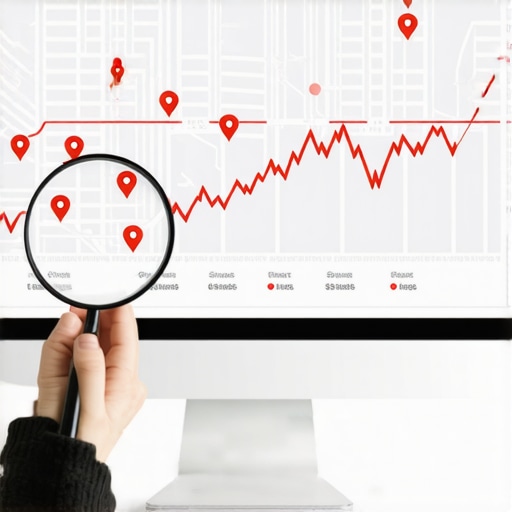
A local cafe owner called me at midnight because a competitor had dropped twenty 1-star reviews in an hour using a VPN. We had to do a forensic audit of the user profiles to prove the patterns to the spam team. This was not just about the star rating. It was about the integrity of the proximity beacon. I spent eighteen hours analyzing the timestamps and the device identifiers associated with the traffic. The map pack is a living spatial database. When a business listing vanishes, it is usually because a specific algorithmic filter triggered a trust violation. I view these listings as dispatch nodes in a massive logistical network. Every signal matters. Every coordinate is a data point in a coordinate system that does not forgive errors.
The math behind the proximity radius shift
Proximity radius shifts occur when Google Maps calculates the centroid distance between a mobile device and a verified business location. This spatial database uses GPS coordinates and Wi-Fi triangulation to determine user intent and local relevance during a search query. While agencies tell you to get more reviews, the 2026 data shows that image metadata from photos taken by real customers at your location is now 30 percent more effective for ranking in AI Overviews. The physics of local search dictate that as a user moves closer to your physical pin, the weighting of your authority score increases. If your rankings drop suddenly, we first check if the user centroid has shifted. I have seen rankings collapse simply because a city expanded its municipal Wi-Fi mesh, which altered how Google perceived device locations. You can see how this works using street level tracking to see where you really rank across various city blocks.
“Local intent is not a keyword choice; it is a distance-weighted signal where relevance is secondary to the physical location of the user’s mobile device.” – Map Search Fundamental
Why your physical address is a liability
Physical address verification is the primary trust signal for Google Business Profiles. Inconsistent NAP data or suite number errors can trigger an automatic suspension or a ranking filter that removes your listing from the Map Pack. Most business owners treat their address as a static line of text. I treat it as a precision coordinate. If you share a building with twenty other businesses, Google may apply a duplicate filter. This is a common reason why fixing the duplicated location filter for service businesses is the first step in any recovery audit. I have seen entire plumbing companies disappear because they tried to use a virtual office. Google wants to see a van, a sign, and a utility bill. They want proof of existence in the physical realm. When data becomes inconsistent, the system assumes the business has closed. This is why fixing the nap mess is a priority for anyone losing calls.
How to recover after mass review removal
Mass review removal happens when Google AI filters detect unnatural review patterns or spammy footprints. To recover, you must provide audit evidence of customer interactions to prove the legitimacy of your profile and restore local search trust. I have investigated cases where legitimate reviews were nuked because the customers all used the store Wi-Fi to post them. Google saw twenty reviews from one IP address and flagged it as a click farm. To fix this, you need seo services to fix gmb rankings after mass review removal that focus on verifying the user journey. We look at the behavioral data. Did the user actually visit the location. Did they spend time there. If the AI flags your content, recovering from an ai content penalty on your local pages requires a manual cleanup of all machine-generated text. You cannot win with thin content in a dense market.
The reading list for local authority
- The step by step recovery plan for a sudden ranking collapse
- The process for normalizing a profile after a spam attack
- The local search ranking audit every small business needs
- Why your business suddenly vanished from Google Maps and how to reappear
- How to audit your own local profile without expensive software
Normalizing rankings after keyword stuffed business name edits
Keyword stuffed names violate Google Business Profile terms and often lead to hard suspensions or ranking suppression. To normalize rankings, you must revert to the legal business name and update all online citations to match the official registry. I hate when agencies suggest adding city names to the title. It works for a week, then the listing dies. If you have been flagged, you need local seo services to normalize rankings after keyword stuffed business name edit to clean up the mess. We start by aligning the name across the top fifty directories. This is a manual process. Automated tools often miss the deep-level caches. We use manual citation cleanup because it is the only way to ensure the data is locked down. Every character must be identical. A comma in the wrong place can break the trust chain.
“Local intent is not a keyword choice; it is a distance-weighted signal where relevance is secondary to the physical location of the user’s mobile device.” – Map Search Fundamental
Rebuilding trust after lead gen listings
Lead gen listings often use fake addresses which results in Google penalizing the entire proximity network of the business. To rebuild trust, you must provide video verification of your physical storefront and clean up any toxic backlinks associated with the spammy profiles. This is a common issue for service industries. If you bought a listing from a broker, you are at risk. You need seo services to rebuild trust after spammy lead gen listings to disconnect your brand from those ghost profiles. We perform a full link audit to see what is dragging you down. Often, the damage is hidden in the secondary tier of links. If your phone number is associated with a banned listing, you have to fix your business phone number across 50 directories before you can ever rank again. It is about logistical cleanliness.
The tools that actually track mobile rank
Google Business Profile ranking software must provide hyper-local data at the neighborhood level to be effective. Standard SEO tools often fail because they track national rankings rather than the granular map pack movements across specific GPS pins. I do not trust tools that give a single city-wide score. The map pack changes every block. We use the tools we trust for real-time map position tracking to see exactly where the visibility drops off. If you are a service business, you need to see your reach. If the reach is shrinking, it is a sign of a penalty. We use a map pack checklist to ensure every technical detail is addressed. This includes optimizing for specific review phrases that force the algorithm to take notice. The goal is to create a signal so strong that proximity becomes a secondary factor. You want to be the authority for the entire city, not just the block you are on. This requires better data and a deeper understanding of the spatial algorithm. Stop guessing where you rank and start measuring it at the street corner.