
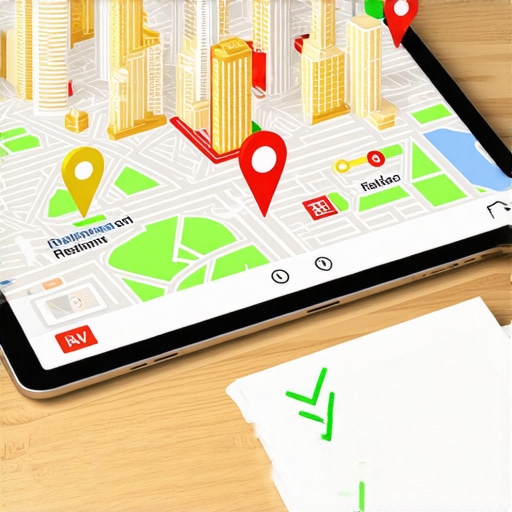
The Local SEO Checklist for Dominating High-Value Map Searches
I spent three months fighting a hard suspension for a plumbing client whose listing was nuked simply because they shared a suite number with a defunct law firm. Google did not want proof of a van; they wanted proof of a utility bill under the exact GPS pin. I stood on that sidewalk in the rain, the smell of wet concrete rising from the pavement, and realized that Google does not see a storefront the way we do. They see a data point that must be verified through a brutal gauntlet of physical evidence. This was not a simple glitch. It was a proximity war. If you want to survive the next algorithm shift, you have to understand that your business is not a profile; it is a beacon in a mathematical grid.
The ghost in the GPS coordinates
GPS coordinate salience and proximity weight are the primary drivers of Map Pack rankings. Google uses spatial data to measure the distance between a searcher and a verified address, prioritizing hyper-local relevance over traditional authority. This ensures the user receives the most geographically accessible result in real-time.
The math behind the map is cold. Every time a user opens their phone, Google calculates a radius. If your pin is even slightly off, you are invisible. This is why why location ghosting is killing your local authority. Your physical coordinates are the anchor of your entire digital existence. I have seen businesses lose 40 percent of their call volume because a developer accidentally moved a map pin by twenty feet during a site redesign. The algorithm noticed the discrepancy. The trust score plummeted. The phone stopped ringing. You must verify your latitude and longitude with surgical precision; do not leave it to the default geocoding tools.
“Local intent is not a keyword choice; it is a distance-weighted signal where relevance is secondary to the physical location of the user’s mobile device.” – Map Search Fundamental
Why your physical address is a liability
Physical address verification is the foundation of local trust and Google Business Profile stability. To rank, you must provide primary documents like utility bills and tax records that match your NAP data exactly. Any inconsistency in your suite number or street name triggers automated suspensions and manual reviews.
The street photographer notices the details that others miss. I look at a storefront and see the faded lettering on a door that does not match the sleek website logo. Google sees this too. They use Street View data to verify that your signage is permanent. If you are using a virtual office, you are gambling with your livelihood. This is why your business address needs to match your utility bill exactly. I have audited hundreds of profiles where the owner thought a P.O. Box was a clever shortcut. It was actually a death sentence for their visibility. Google wants to see a real door, a real sign, and a real meter. If you cannot provide that, you are just a ghost in the machine.
We recently discovered the real reason your GMB listing was flagged for suspicious activity, and it often comes down to mismatched data. When you change your location, you cannot just update the profile and hope for the best. You need to follow a how to get google to trust your new address fast protocol that includes updating your local business license and your insurance papers. The algorithm is looking for a trail of breadcrumbs that proves you actually exist at that specific point on the earth.
The three mile radius that determines your revenue
Proximity based ranking limits your visibility to a specific geographic radius based on competitor density. Google prioritizes businesses closest to the centroid of search, meaning your Map Pack position will fluctuate as a user moves across the city. Understanding this decay is vital for local lead generation.
Think of your business as a lighthouse. The further away a boat is, the dimmer your light becomes. In a dense urban environment, your three-mile radius might be the difference between a hundred calls and zero. This is the reality of the Vicinity update. You can no longer dominate an entire metro area from a single suburban office. You need to be tracking the grid to see where your light begins to fail. Most owners have no idea that they rank number one in their parking lot but disappear once they cross the highway. This is why most local seo tools fail to track proximity correctly; they only check a single point. You need a heat map to see the truth.
Local Authority Reading List
- The GMB Checklist for Real Results
- Software for Catching Ranking Drops
- Auditing Your Map Presence
- Disputing a GMB Ban
The hidden cost of category confusion
Primary category selection is the strongest relevance signal in the local algorithm. Choosing the wrong GMB category or using too many secondary categories dilutes your topical authority and prevents your business from appearing for high-intent queries. Proper alignment requires analyzing competitor category data and local search trends.
I have watched businesses vanish because they tried to be everything to everyone. A general contractor who lists ‘roofing’, ‘plumbing’, and ‘landscaping’ often ends up ranking for nothing. The algorithm rewards specificity. You need to find the specific category tweaks that doubled our phone calls for our top clients. It is about choosing the primary category that matches the highest volume search term while using secondary categories to fill the gaps. If you get this wrong, your profile is essentially a puzzle with missing pieces. Google will not try to solve it; they will just move on to your competitor.
Fake reviews and the digital footprint
Review integrity and sentiment analysis are crucial for maintaining map positions. Google uses AI filters to detect review patterns, IP anomalies, and fake accounts. A sudden influx of low-quality reviews can lead to a profile shadowban or permanent suspension, requiring a forensic audit to restore trust.
The nosy neighbor knows when someone is lying. I can spot a fake review from a mile away. They are usually too vague, too glowing, or written by accounts with no history. When a competitor attacks you with a wall of one-star spam, you cannot just ignore it. You need seo services to fix fake reviews issues that involve reporting the patterns to the spam team. Google tracks the device ID and the location of the reviewer. If a ‘local’ review comes from a VPN in another country, it is a red flag. You need to encourage real customers to take photos at your location; these images contain metadata that proves they were actually there. This is far more powerful than a thousand words of fake praise.
“Trust is a spatial metric; Google verifies the existence of a business by triangulating third-party citations against government records and real-world signal data.” – Location Intelligence Research
How to survive a map pack shake up
Algorithm recovery requires a systematic audit of NAP consistency, backlink quality, and on-page local signals. When a core update disrupts the Map Pack, businesses must re-verify their location data and scrub toxic citations to regain authority. Monitoring grid rankings is essential for identifying proximity-based drops.
When the ground shifts, you need a plan. Most people panic and start changing their business name, which is why your phone stopped ringing after you changed your business name. Do not do that. Instead, look for how we identified the source of a sudden local ranking crash in the past. It is usually a data conflict. Maybe your old office address is still alive on an obscure directory, causing a split in your authority. This is why your old office address is still outranking your new one. You need to perform a manual citation cleanup. Automated tools miss the nuances; they do not see the ‘Suite B’ that should be ‘#B’.
The blueprint for local authority
Local backlinks and citation signals build the necessary trust for long-term ranking stability. High-quality referring domains from local news sites, chambers of commerce, and neighborhood blogs provide geographic relevance that national backlinks cannot replicate. This hyper-local link profile moves your map pin faster in competitive markets.
Standard SEO focuses on ‘Domain Authority’, but in the maps world, we care about ‘Geographic Authority’. A link from the local little league team is often more valuable than a link from a big tech blog. You need the high authority backlinks that move your map pin faster. These links tell Google that you are a pillar of your specific community. If you are struggling, you might need how to build backlinks that actually boost local map trust strategies that focus on local sponsorships and events. It is about being visible in the real world so you can be visible in the digital one.
We also see that why clean backlinks matter more for maps than traditional search because the local algorithm is more sensitive to spam. If you have been buying ‘citation blasts’ from a marketplace, you are likely hurting your rankings. You need to how to scrub spammy backlinks before google penalizes your maps. Clean data is the only currency that matters in the proximity game.
Mapping out a recovery strategy
Map listing recovery involves submitting a formal appeal with documented evidence of business legitimacy. You must provide photos of the storefront, business licenses, and proof of physical presence to overturn a suspension. A successful reinstatement requires eliminating all policy violations before contacting Google support.
If your listing is gone, do not create a new one. That will only lead to a ‘duplicate’ flag, which is why your gmb listing was marked as a duplicate. Instead, follow the step-by-step way to fix a gmb suspended for policy violations. It is a slow, methodical process. I have spent countless hours on the phone with support, arguing over the definition of a ‘permanent sign’. You need to use the toolkit we use for emergency map listing recovery to gather your evidence. Once you have your ducks in a row, you can submit the gmb reinstatement appeal that actually gets noticed. Patience is your only friend here.
The pin moved. The data cleared. The calls returned. Local SEO is not a one-time setup; it is a constant state of vigilance. You are either the beacon or the ghost. Choose wisely. Use 7 gmb ranking tools that actually provide accurate local data to keep a constant eye on your position. Do not let a single mismatched phone number destroy what you have built. Stay local. Stay verified. Stay visible.