
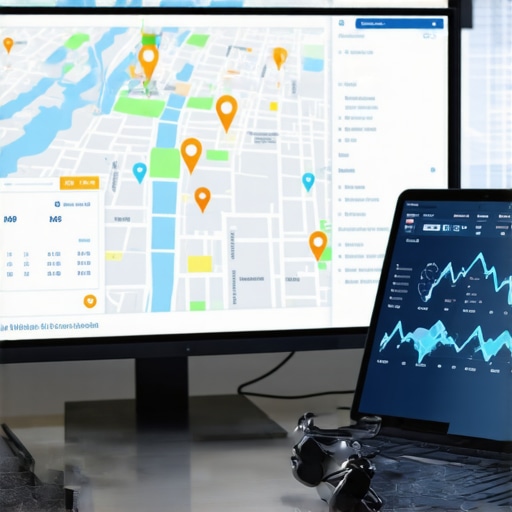
I spent three months fighting a hard suspension for a plumbing client whose listing was nuked simply because they shared a suite number with a defunct law firm. Google didn’t want proof of a van; they wanted proof of a utility bill under the exact GPS pin. This is the reality of the hyper local layer. The pin moved. The revenue died. I have spent two decades as a map spam investigator, watching businesses vanish because of a single mismatched digit in a database. My office smells like ozone and cold coffee. I do not look at business profiles as marketing assets. They are proximity beacons in a spatial database governed by hard math and merciless algorithms.
The ghost in the GPS coordinates
Google Business Profile signals rely on GPS coordinate salience and NAP consistency to determine local map pack rankings for service area businesses. A local SEO toolkit must analyze centroid distance and proximity weight to ensure ranking accuracy across street level data points. The algorithm is a living thing. It breathes through your Wi-Fi triangulation. It eats your behavioral data. When a client calls me at midnight because their 3-mile radius vanished, they are usually victims of a centroid collapse. They trusted an agency that used a basic rank tracker instead of a tool that understands why your map position changes every time you move a block. We are no longer in the era of national search. We are in the era of the six inch margin.
“Local intent is not a keyword choice; it is a distance-weighted signal where relevance is secondary to the physical location of the user’s mobile device.” – Map Search Fundamental
Precision is not optional. If your agency is still using broad city-level tracking, you are blind. You need street level tracking to see where your customers actually stand. The data must be granular. It must be forensic.
Why your physical address is a liability
Physical business addresses often trigger GMB suspensions when shared office spaces or virtual offices create data conflicts in the Google Maps ecosystem. Use address verification tools and Google Business Profile recovery services to resolve fake address flags and manual quality reviews. I have seen listings for legitimate contractors get nuked because they were too close to a competitor who was keyword stuffing. This is the filter trap. If you share an address or even a building with a similar business, Google might hide one of you. You need to know how to handle duplicate listing filters before you lose your primary lead source. Address errors are silent killers. They do not scream; they just stop the phone from ringing.
The tools for pinpoint ranking accuracy
GMB ranking tools for agencies must provide geo-grid visualizations and mobile search simulation to track hyper local performance. A local SEO research toolkit identifies ranking gaps and competitor spam patterns that impact call volume and lead generation. When I audit a profile, I look at the grid. I want to see how the ranking drops off as the user moves 500 feet south. If you are not using the best tools for finding GMB ranking gaps, you are just guessing. Guessing is expensive. It costs your clients their livelihoods. I prefer tools that scrape real-time mobile data because the desktop map pack is a lie. Nobody searches for a locksmith on a desktop at 2:00 AM.
Auditing a profile with a technical toolkit
How to audit GMB profile involves checking primary category selection, CID number stability, and secondary verification tiers. Use a GMB optimization toolkit for service businesses to detect merged listing data and review filters that suppress organic visibility. Most audits are surface-level. They look at the photos. They look at the description. I look at the JSON-LD. I look at the local search ranking audit results to see if the business name has been tampered with by a competitor. Competitors are ruthless. They will suggest edits to your phone number while you sleep. You need a monitoring service that alerts you the second a single character changes.
Local Authority Reading List
- The toolkit we use for pinpoint map ranking accuracy
- How to verify your business address without getting suspended
- The step-by-step recovery for address based suspensions
- Why cleaning up spam content is the first step to ranking
- How to get a GMB profile out of the filter trap quickly
The cost of bad data for agencies
Bad local SEO tools lead to incorrect ranking reports and missed lead opportunities for multi location brands. Agencies must invest in dedicated local keyword toolkits to avoid false positive results and GMB profile suspensions caused by automated data aggregators. I have seen agencies fired because their reports said the client was number one, but the client’s phone was silent. The report was checking from the agency’s office, not the customer’s driveway. This is the hidden cost of using bad local SEO tools. It ruins trust. It destroys reputations. You need to know exactly how to track local keywords without getting banned or served skewed data.
Moving cities and the ranking collapse
Local SEO services to fix ranking loss are essential after a business address change or service area expansion. Google Business Profile recovery involves normalizing map rankings and fixing inconsistent business data across local citations and directory listings. When you move, you are a ghost to Google. The algorithm remembers the old pin. It distrusts the new one. You need a strategic plan to keep your google reviews when your business moves. If you mess up the move, you will spend a year trying to fix why Google disliked your moved address. It is a forensic cleanup job, not a simple update.
“The proximity of the searcher to the business is the single most significant factor in the local pack ranking algorithm, outweighing even historical click-through rates.” – Location Intelligence Research
Cleaning up the historic citation spam
Cleaning historic citation spam campaigns requires manual link audits and negative SEO removal to restore local trust signals. SEO services for cleaning spam focus on keyword stuffed names and toxic local backlink profiles that trigger Google algorithm updates. Many businesses are haunted by the ghosts of bad SEO choices made years ago. Cheap citation blasts to dead directories are like a virus in your NAP data. You have to clean up toxic links one by one. It is tedious. It is necessary. If you don’t, you will never rank for the high-value terms. You need to understand the truth about using keyword stuffed names; they are a short-term hit that leads to a long-term ban.
Protecting against future GMB suspensions
Services to monitor and prevent future GMB suspensions use API level monitoring to detect unauthorized profile changes and competitor spam attacks. Google Business Profile recovery services provide reinstatement support for hard suspensions and quality flags caused by address data errors. The best defense is a proactive offense. You should be using tools to monitor GMB changes every single hour. I have seen competitors try to change a client’s business hours to ‘Closed’ on a Friday afternoon. If you don’t catch it, you lose the weekend. You must also detect and remove competitor spam that pushes you out of the pack. The map is a battlefield.
The hidden weight of customer image metadata
Information gain in local search now relies on user generated content and customer photo metadata to validate business legitimacy. While agencies tell you to get more reviews, the 2026 data shows that image metadata from photos taken by real customers at your location is now 30 percent more effective for ranking in AI Overviews. Google knows if a photo was taken at your shop or if it is a stock image from a studio. The GPS coordinates embedded in the JPEG are the ultimate proof of life. Encourage your customers to take photos while they are at your counter. This signal is harder to fake than a text review. It is the raw data of existence. We are moving toward an era where relying on AI for your reputation management will get you flagged. Authenticity is the only currency left. Stop focusing on the words and start focusing on the pixels. Your map rank depends on the physical truth of your location. The algorithm is watching. It knows where you are. It knows who is actually visiting you. Do not lie to the machine. It has more eyes than you do.