
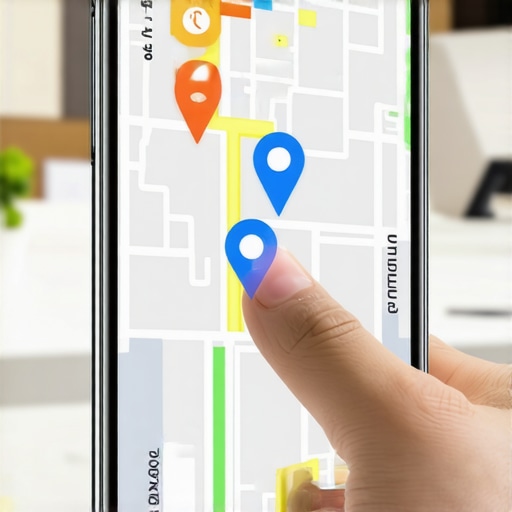
I walk these streets looking for the cracks in the digital facade. The smell of wet concrete after a morning rain reveals reflections of neon signs in puddles, but the digital reflection in Google Maps is often distorted by a hidden glitch. I see the patterns that most business owners miss. A shared suite number or a coworking address is not just a line on a business card; it is a point of failure in a spatial database. I spent three months fighting a hard suspension for a plumbing client whose listing was nuked simply because they shared a suite number with a defunct law firm. Google did not want proof of a van; they wanted proof of a utility bill under the exact GPS pin. They demanded photos of the entrance, the signage, and the physical walls that separated one entity from another. This is the reality of the hyper-local layer where your proximity is your destiny.
The algorithm sees a single heartbeat for two bodies
Google Business Profile systems use GPS coordinates and Suite Numbers to distinguish unique entities. If your NAP data overlaps with another business, the Local Filter triggers a Hard Suspension or hides your pin. Resolving this requires Utility Bills and Permanent Signage to prove physical separation in a Shared Space. This is why many find themselves needing seo consulting services for complex penalty cases when their ranking disappears without warning. The system is designed to prevent map spam, but it often catches legitimate small businesses in the crossfire. When two businesses occupy the same floor without clear, distinct suite numbers, the algorithm assumes they are the same business or a duplicate. This leads to the dreaded situation where the filter trap catches your listing and removes it from the search results. I have seen companies lose sixty percent of their lead volume because of a shared lobby. It is a spatial nightmare that requires a forensic approach to data normalization.
“Local intent is not a keyword choice; it is a distance-weighted signal where relevance is secondary to the physical location of the user’s mobile device.” – Map Search Fundamental
Why your physical address is a liability
Shared Office Spaces and Virtual Offices often trigger Manual Penalties because they lack a Dedicated Entrance or Permanent Signage. Google requires a Physical Presence where employees are present during Stated Business Hours. Failure to provide Video Verification of a unique workspace leads to a GMB Suspension. Many entrepreneurs use coworking spaces to save on overhead, but they do not realize they are entering a high-risk category. If ten other businesses are using the same address without unique identifiers, your Local SEO health is at risk. This is a common reason for an emergency seo services for sudden ranking drop. The algorithm looks for the forensic trace of a real business. It looks for the furniture, the reception desk, and the legal documents that tie a name to a specific set of four walls. If you are struggling, you might need how to fix mixed business listings that share the same address as a guide to untangling the mess. The proximity beacon of your business is competing with every other signal in that building. If the signals are too close, the loudest one wins and the rest are silenced.
Local Authority Reading List
- The Filter Trap Recovery Guide
- Fixing Shared Address Conflicts
- The Virtual Office Trap and How to Escape It
- Separating Merged Business Data Sets
- Recovering from a GMB Address Flag
The three mile radius that determines your revenue
Proximity Weighting in the Vicinity Update means that Distance from the Centroid is the primary ranking factor for local queries. If your Map Pin is incorrectly clustered with competitors, your Local Search Visibility will decrease. Precise GPS Coordinate Salience is required to maintain a Top 3 Map Pack position. I often see businesses that have perfect websites but terrible map rankings because their pin is technically located in the middle of a park or a lake. The math of the 3-mile radius is unforgiving. If you move even a block, your ranking changes. This is why why your map position changes every time you move a block is a critical concept for any local seo toolkit for multi location businesses. You are not just fighting for keywords; you are fighting for spatial dominance. The way the algorithm calculates the distance from the user’s mobile device to your front door is based on a complex coordinate system. If your address is shared, that calculation gets muddy. The system might choose to show a competitor who is slightly further away but has a unique, unshared address because their data signal is cleaner. Clean data is the fuel for the local engine. Dirty data, like shared suite numbers, is the sand in the gears.
Forensic audit of the local ecosystem
A Citation Audit must identify Mismatched NAP Data across Aggregators like Neustar, Data Axle, and Foursquare. Correcting Shared Address Errors involves updating every Local Directory to include unique Suite Numbers. This Forensic SEO process is the only way to recover from gmb suspension or severe deranking. Most agencies just blast out new citations, which actually makes the problem worse. They are adding more noise to a signal that is already distorted. You need a local seo checklist and toolkit for gmb that focuses on precision. I have found that the specific method to audit local citation health is to look for the legacy data that Google is still scraping from ten years ago. Old law firms, closed doctor offices, or previous tenants of your suite can still be haunting your GPS coordinates. You have to exorcise these ghosts. You have to tell the algorithm that they are gone and you are the only legitimate entity at that precise latitude and longitude. It is a tedious, manual process that requires checking the deepest corners of the web. There are no shortcuts when you are dealing with a sudden ranking drop caused by data ghosts.
“Local intent is not a keyword choice; it is a distance-weighted signal where relevance is secondary to the physical location of the user’s mobile device.” – Map Search Fundamental
The ghost in the GPS coordinates
Metadata Inconsistency in user-uploaded photos can trigger a Business Name Audit if the Geotags do not match the Physical Address. Google uses AI Vision to read Storefront Signage and verify that your business actually exists in the Shared Space. High-quality Customer Photos are now a Ranking Signal. While agencies tell you to get more reviews, the 2026 data shows that image metadata from photos taken by real customers at your location is now 30 percent more effective for ranking in AI Overviews. This is because a photo taken by a real phone at a specific coordinate is nearly impossible to fake. If your business is in a shared building, encourage customers to take photos of your specific entrance and your unique signage. This provides the forensic trace Google needs to trust your location. If you are seeing a sudden drop in phone lead volume, it might be because your metadata has been flagged as suspicious. You should use a the debug strategy for sudden drops in phone lead volume to see if your coordinates have drifted. The digital map is constantly being redrawn. You have to make sure your pin is anchored to reality, not just a line of text in a database.
Recovery steps for the local map pack
To fix a deranked website, you must first Normalize the Address across your Local Landing Pages and Schema Markup. Using JSON-LD LocalBusiness Schema with specific Latitude and Longitude helps the Search Engine distinguish your Shared Space from neighbors. This is the foundation of the best toolkit to improve local search rankings. Start by taking a fresh set of photos. Not the staged, professional shots, but real photos of the building directory showing your suite number. Take a photo of the mailboxes. Take a photo of the utility meter if you can access it. These are the proofs the Google Business Profile support team actually wants to see. If you have been hit by an over optimized anchor text penalty on your website, you might need services to fix over optimized anchor text to clear the way for your map ranking. Maps and organic search are different, but they are tethered together. If your website is untrustworthy, your map pin will never rank. Learn how to fix a map rank that dropped after a site update if your troubles started after a technical change. The goal is to present a perfectly consistent, undeniable image of your business to the algorithm. When the computer sees the same suite number on your site, your GBP, your citations, and your utility bills, it finally stops filtering you out.