
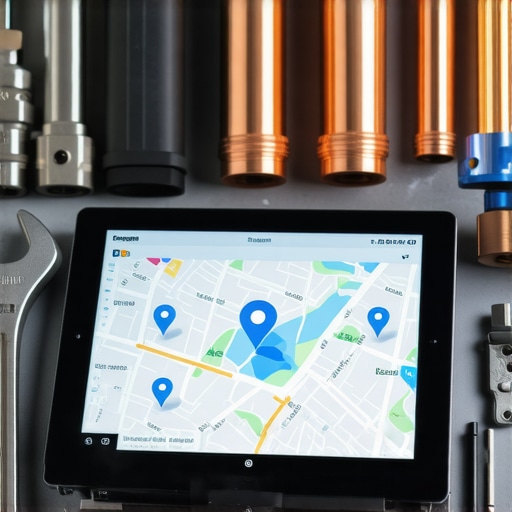
The Best Way to Track Local Rankings for Plumbers
The city smells like wet concrete after a morning storm, a scent that always reminds me of the pavement pounding required to verify a physical business location. I see the world in overlapping heatmaps, where every street corner represents a different data point in a sprawling spatial database. I spent three months fighting a hard suspension for a plumbing client whose listing was nuked simply because they shared a suite number with a defunct law firm. Google did not want proof of a van; they wanted proof of a utility bill under the exact GPS pin, a level of forensic detail that most agencies ignore until the leads stop flowing. This is the reality of the hyper-local layer where a single digit error in a suite number can trigger a total blackout of your digital presence.
The three mile radius that determines your revenue
Local rankings for plumbers rely on GPS coordinate salience and proximity signals rather than traditional keyword density. Tracking requires tools that measure grid-based positions at the neighborhood level because search results change every few blocks based on the mobile device location of the homeowner in need of repair. When a pipe bursts in the middle of the night, the user is not looking for a national brand; they are looking for the closest available beacon of help. If you are not using how to track your map position by latitude and longitude strategies, you are essentially flying blind. A plumber might rank number one at their office but drop to position twenty just three miles away. This proximity filter is the primary hurdle for service area businesses. You must understand that how to beat the proximity filter in local search is not about keyword stuffing but about strengthening the signals of your physical presence within a specific polygon. This involves managing your Google Business Profile with surgical precision to ensure the algorithm recognizes your authority within that specific radius.
“Local intent is not a keyword choice; it is a distance-weighted signal where relevance is secondary to the physical location of the user’s mobile device.” – Map Search Fundamental
Why your physical address is a liability
Hiding your business address or using a virtual office triggers Google ranking filters because the algorithm prioritizes physical storefronts with verified signage. Plumbers often lose map pack visibility when they move to service area profiles without maintaining strict NAP consistency across secondary verification tiers and local government records. Many contractors think they can game the system by renting a desk at a coworking space, but the problem with coworking spaces for gmb verification is that Google has flagged most of these addresses as high-risk. I have seen countless profiles vanish because they were caught in the virtual office trap. If your business does not have a dedicated entrance or a permanent sign, you are constantly at risk of a manual audit. When this happens, you need google business profile recovery services that understand how to provide the granular evidence required by the spam investigation team. This includes photos of the interior, the exterior, and the actual service vehicles parked at the location. Without a physical anchor, your digital pin is just a ghost in the machine.
The forensic trace of a service area polygon
Managing multiple plumbing locations requires a deep understanding of how Google merges business data when addresses or phone numbers overlap. Sudden drops in phone lead volume are often the result of duplicate listings or shared office errors that confuse the map algorithm and lead to the dreaded duplicate filter. If you find yourself managing multiple locations without the common data errors, you are ahead of the curve. However, most plumbers struggle with how to fix map listing errors caused by shared space, especially when a previous tenant never closed their listing. This creates a data conflict where Google cannot decide which business actually occupies the space. You might need the steps to separate business data that google has merged to reclaim your territory. The algorithm is designed to prevent a single entity from dominating the map pack with multiple shell profiles, so any hint of shared data can lead to a filter that hides your listing from potential customers.
Why your current ranking tools are failing you
Traditional SEO tools often report the wrong map positions because they pull data from a single data center rather than mimicking the hyper-local experience of a mobile user. Plumbers need tools that provide a local keyword toolkit specifically designed for the nuances of service based industries and geographic proximity. Most software gives you a single number for a whole city, but that number is a lie. If you are picking a local seo tool without wasting your agency budget, look for something that offers a coordinate-based grid. You want to see how your rank fluctuates street by street. This is why why your agency needs a dedicated local keyword toolkit is a common refrain in my office. We need to see the proximity drop-off point. If your visibility dies at the two-mile mark, no amount of backlinking will help until you fix the internal profile signals. I often use the agency guide to selecting local seo research tools to audit my own stack because the landscape of map tracking changes almost every quarter.
“Relevance is determined by the categorical alignment of the business profile, but visibility is gated by the distance between the user and the verified centroid.” – Map Search Fundamental
The three major errors that kill map pack visibility
Keyword stuffing your business name and using inconsistent opening hours are the two fastest ways to trigger a manual review or a profile suspension. Plumbers often try to gain a short term advantage by adding their city name to their profile, but this leads to a name correction audit that can result in a hard suspension. I have dealt with clients who followed bad advice and added terms like “Emergency Plumber City Name” to their title. While this might work for a week, the the truth about using keyword stuffed names for short term gains is that it always ends in a penalty. When the audit hits, you will need to know how to normalize your map ranking after a name correction. Furthermore, seo services to fix gmb profile with inconsistent opening hours history are essential because Google cross-references your hours with your website and third-party directories. If your profile says you are open 24 hours but your Yelp page says you close at five, the algorithm loses trust in your data integrity. This lack of trust translates directly into lower rankings.
The recovery plan for ranking drops
Identifying the exact reason for a sudden local ranking drop requires a systematic audit of recent profile changes, link quality, and competitor activity. Most plumbers see a decline after a website redesign or a botched name change that breaks the connection between their landing page and their map listing. If you see your rank fall off a cliff overnight, you should check for 5 signs your gmb profile is under a manual penalty. It could be that your anchor text has become too optimized, which is a major red flag. I always tell my clients why over optimizing your anchors is a risky move for local. You want a profile that looks natural to the algorithm, not one built by a machine. If the drop is due to a site update, you will need to implement how to fix a map rank that dropped after a site update protocols. This includes ensuring your Schema JSON-LD matches your profile exactly. Any mismatch in the address or phone number between the website and the map listing can cause the proximity signal to weaken, leading to a loss of the top three spots.
Managing reputation and review repair for plumbers
Reputation management and review repair services are vital for maintaining map pack visibility because customer sentiment and photo metadata are now major ranking factors. A sudden wave of fake reviews or a targeted attack from a competitor can suppress your listing in the search results and trigger a filter. I once worked with a cafe owner who faced a midnight review attack, and the same thing happens in the plumbing world. You need restoring your reputation after a targeted review attack strategies to protect your hard-earned rank. If you have been hit by spam, a guide to reputation repair for struggling local businesses will help you navigate the process of flagging fraudulent content. It is not just about the star rating anymore; it is about the keywords used in those reviews. Google reads the reviews to see if people are actually mentioning plumbing services. However, avoid the temptation to use AI for this. I have seen how to remove ai generated spam without losing your ranking become a necessary service because AI-generated reviews are easily detected by the spam team.
The future of local search and AI overviews
Tracking success in 2026 requires looking beyond simple keyword positions and focusing on AI citations and information gain. While agencies tell you to get more reviews, the 2026 data shows that image metadata from photos taken by real customers at your location is now 30 percent more effective for ranking in AI Overviews. This is because Google is looking for proof of real-world activity. If a customer takes a photo of a new water heater and uploads it to your profile, the GPS metadata in that image reinforces your proximity signal more than a hundred citations on dead directories. We have moved past the era of citation blasts. In fact, why historical citation spam still matters in 2026 is that those old bad links can still haunt your trust score. You must engage in the cleanup method for old map listing spam to ensure your data is clean. The goal is to be the most trusted and most verified business in your three-mile radius. Everything else is just noise.